
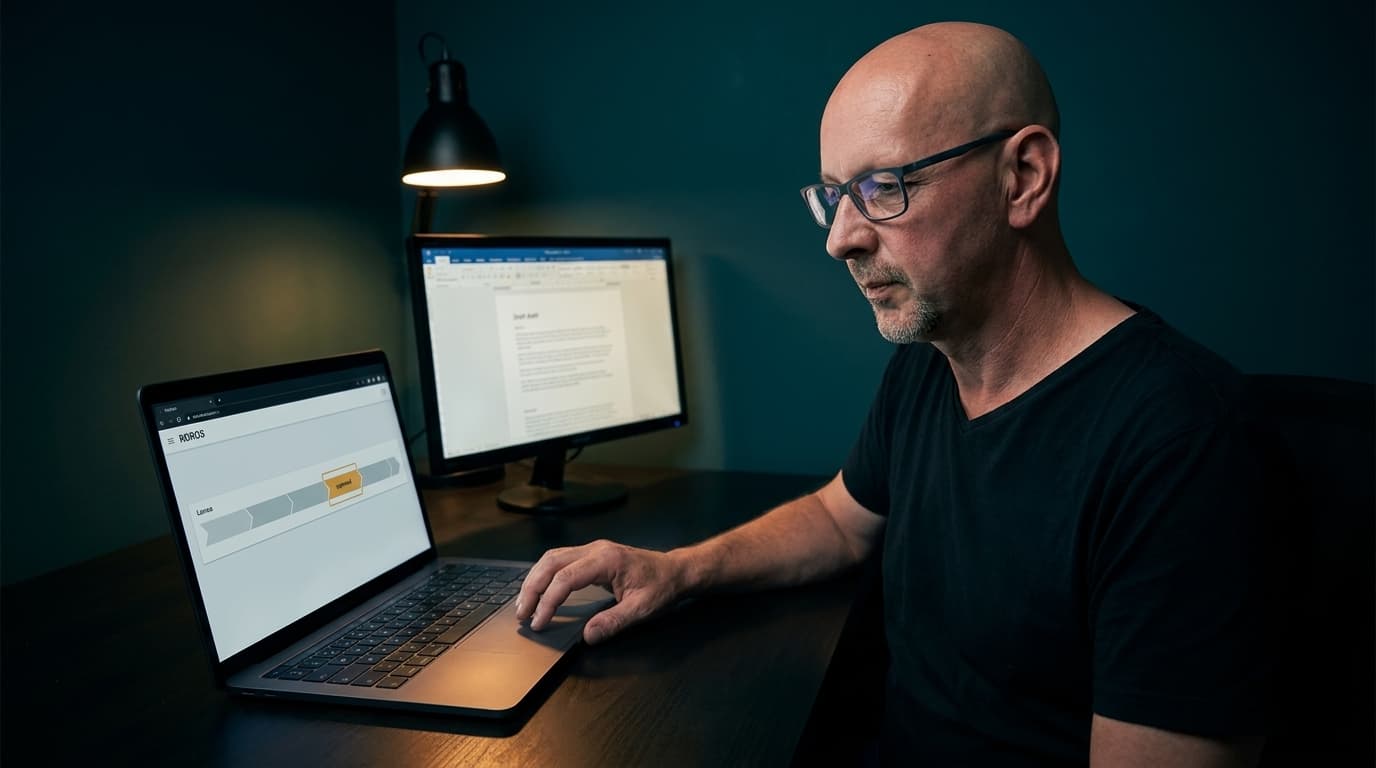
A human doesn't write this blog alone. One operator, one Role Contract, one proof.
An AI operator drafted this article, not a human hand. It may draft and ship a full set every week, but it may not publish. Why this blog is the most honest proof that governed AI operators actually work.
In short: An AI operator drafted this post, governed by a Role Contract. No human typed it alone. A responsible human reviewed and approved it before it went live. That workflow is the proof this piece is about.
An AI operator drafted this article. At Rocket Routine that is an ordinary Monday, not a stunt.
The claim: no human types this alone
Every week this operation produces a blog post in two languages, several LinkedIn posts, a set of X posts, and a video. For almost all of it, the first draft comes from no human hand. Right now that is a claim almost everyone is making. It gets interesting at two specific points: what "writes" actually means here, and who decides whether the text goes live.
What an AI operator is
Give a language model an instruction and you get text back. An AI operator is a level up: an AI-native role with a defined mandate, not an assistant that answers on request. The difference is exactly the one between reactive and governed. An assistant waits for your question. An operator owns an outcome, knows its limits, and proves quality.
Who counts as an operator in a company, and how that differs from a human and from a pure knowledge source, is set out in the Actor Registry. How an operator takes on responsibility in stages, from Shadow to Copilot to Autopilot, is in this article.
The Role Contract that governs it
The content-marketing operator behind this blog runs on a firm foundation: a Role Contract. It sets out what the role owns and what it does not, which outcomes it is accountable for, which routines it runs, what quality it has to prove, and where its decision rights stop. That makes a Role Contract something other than a prompt, and why that distinction holds is spelled out here.
The most important line in that contract is a boundary. The operator may draft, phrase, work in two languages, and ship a complete content set every week. It may not publish. Write access to the CMS only opens once a human has reviewed and approved the text.
The operator can ship a full content set every week. It cannot publish a word of it.
How this post was actually produced
The flow follows the I2I loop, from intent to impact: the week's topic becomes an intent, the intent a draft, the draft a published text once it passes review. The week moves as a single lane in the Control Tower, visible from idea to approval. The principle behind it is the I2I loop.
Before a draft enters approval, it runs a fixed check. No em-dashes. Terms match the vocabulary exactly. A LinkedIn post carries one idea, not three. That is Poka Yoke, translated from manufacturing to knowledge work: the error is prevented by construction, before it happens. FTT, the share of outputs that pass that check on the first pass, is the metric the role is measured on. Why verification comes before trust is its own piece.
The most honest version of this shows up in a mistake. A review of the previous week's article flagged eleven places where the operator reached for the same rhetorical construction, a pattern that makes prose start to sound like a machine. Instead of just smoothing that one text, the fix became a Learning artifact: a standing rule in the edit patterns that now binds the operator on every article, at most one such pattern per piece, reserved for the strongest moment.
A learning is only real when it changes an artifact. This paragraph obeys a rule that came out of last week's review.
The operator that got it wrong is the same one that now avoids it, because the correction lives in the system rather than in anyone's memory.
Who decides what ships
The flow is deliberately staged: the operator produces, a review checks, and the final approval sits with a human. That is what "the CEO stays sovereign" looks like in practice. Sven writes none of these sentences himself, and still nothing goes live without his sign-off. His sovereignty lives at the approval, not at the keyboard.
Which decision belongs at which level is not a gut call. It follows a clear sort by impact, Root, Trunk, Branch, Leaf, described in its own article. The operator decides at the Leaf level inside its contract. Everything above that reaches the human.
Why this is proof
Rocket Routine is Company 0, the first company running on Rocket Routine OS. Content production runs in Growth Mode: the operators produce, Sven leads by exception. You can see exactly where the exception sits in one place. The monthly Build Log has a section about concrete events from Sven's actual month. That section is built so no operator can fill it. Without a real detail from Sven, the line stays empty, and the escalation trigger pulls the task up to him.
The same principle underpins this entire blog. It is the smallest slice of a system that lays the same governance across eleven domains and sits on a written constitution. Which domains those are, and why every company has the same structure, is in the eleven domains.
This is not marketing about an operating system. It is an artifact the operating system produced.
What this means for your company
If you are weighing whether to let AI operators touch real work, the real question is the governance they run under: which decision rights, which tool access, which quality check, and which path from mistake to improvement. That they can produce text is long settled.
This blog is that answer in its cheapest form. When something breaks here, it costs a paragraph, not a customer. That is exactly why it is the right place to show the mechanics in the open: the same Role Contracts, the same approval gate, the same verifiable execution that would apply if an operator ran your reporting or your support.
A concrete test for your own company: take a task you recently handed to a language model and ask four questions:
- What does the role own, and where does it stop?
- What may it change without approval?
- How is it checked that the output is right?
- What happens to a mistake after it occurs?
If any of those stays open, what you have so far is a well-aimed prompt, not yet an operator under governance.
If you run a founder-led B2B company with 15 to 50 employees and want to see AI operators run under governance instead of hope: rocket-routine.com
FAQ
Who writes this blog?
The first draft is written by an AI operator, the content-marketing operator at Rocket Routine. A human reviews and approves it before it goes live.
What is an AI operator?
An AI-native role with a Role Contract: a mandate, decision rights, quality duties, and limits. Unlike an assistant, an operator owns an outcome rather than waiting to be asked.
What is a Role Contract?
The governance artifact that defines a role: scope, outcomes, routines, decision rights, tool access, quality proof, and escalation. It turns a language model into a reliable operator.
Is this fully autonomous?
No. The operator drafts and ships, but every publication passes a human review and approval. The CEO stays sovereign.
Want to build this in your own company?
Rocket Routine OS is the operating system behind these articles, and it is not open yet. Join the waitlist and you hear first, get a fortnightly honest account of what is working and what is not, and move further up the list with every referral.
Join the waitlistWant to understand the whole system?
The entire architecture of Rocket Routine OS as a PDF — 20 pages, freely available, no form required.
Download whitepaper (PDF)