AI Strategy for Companies: Five Questions for Founders
An AI strategy does not need a thick document. Five questions are enough: what for, which area first, how much on its own, who decides, and how you see whether it works.
Sven O. Rimmelspacher is an entrepreneur and software and AI expert. He has been building software for more than 40 years, has worked with AI since 2016 and has worked on quality and process improvement for more than 30 years. Today he leads the about ZERO group of software companies, including Rocket Routine, and writes and speaks about leadership, strategy and AI, including in his book "Auf geht's!" on the agile transformation of his company.

Books
Interviews and talks
An AI strategy does not need a thick document. Five questions are enough: what for, which area first, how much on its own, who decides, and how you see whether it works.
The Weekly looks at the week, the Quarterly at the quarter. Once a year it is about direction: does your purpose still hold, is the vision right, and which goals do you set?
Yearly goals need something to hang on. Before planning for next year begins: what sets vision, mission and values apart, and how to write them down in five steps.
The Weekly looks at the week, the Monthly at the system. Once a quarter it is about direction: what did the last quarter bring, and which goals apply from now on?
The Weekly is about the week. Once a month there is a bigger question: is the system working for us? In Rocket Routine OS, that question has its own meeting: the Monthly.
Every function planned for the pilot is built. Now come 2 to 3 weeks of testing, then the pilot projects start. This is what the system does today.
If you want to know how the company is doing, you usually need an appointment: someone collects numbers from several tools and builds an overview. In Rocket Routine OS one question in the chat is enough, even when a number is missing.
The weekly is the meeting everyone knows and nobody likes: no preparation, different questions every week, forgotten by Wednesday. In Rocket Routine OS, the Navigator opens the meeting by itself and leads through it with four fixed questions.
Talk to your company. It answers, it gets the work moving, and you decide. Rocket Routine OS at a glance: the agentic operating system with AI agents.
Role one writes the article, role two posts about it. For weeks that handoff ran on a quiet convention, one that held as long as someone remembered it. A signal is different: a state the second role can query itself, every time, whether or not anyone happens to be watching.
Role one worked, so repeating the recipe feels obvious. That's the wrong move. Role two follows two different criteria: what your first review revealed about your own checking, and how cleanly the handoff between the two roles is defined.
The first routine is handed over, the operator has been running for two weeks, and the question underneath is still open: is this actually going well? The usual answer is to read everything. That is understandable and it is the wrong instrument.
Almost everyone reaches first for the task that eats the most time. That is understandable and usually the wrong start. Four criteria decide which routine suits going first, and which one is better left for later.
A Role Contract sounds like a document you need a consultant for. The first one takes an afternoon if you start in the right place. Eight components, and the mistake almost everyone makes in each.
Most founders can tell you how their company is doing. Very few can tell you which operational stage it is on, and almost everyone places themselves one too high. The difference between stages decides which next step is worth taking at all.
As soon as AI operators are meant to do real work, the data and access question arrives. Two very different questions usually get mixed together. One belongs to your provider, the other belongs to you, and the second one decides how much damage is possible at all.
The most common objection to AI operators does not come from the technology. It comes from your own team. The usual response is persuasion, and it is usually the wrong lever, because resistance almost always points at something the process left unsettled.
Describe governance for AI operators and you quickly hear the same objection: this is just bureaucracy with AI on top. The objection is fair, because most people have only ever experienced process as dead weight. The difference between governance and theater is still nameable.
Every serious conversation about AI operators ends at the same question: what happens when the thing gets it wrong? The honest answer is not that it won't. It is that an operating system plans for the failure, catches it early, and turns it into a change to an artifact.
An AI operator drafted this article, not a human hand. It may draft and ship a full set every week, but it may not publish. Why this blog is the most honest proof that governed AI operators actually work.
There are two ways leadership fails. You see everything and become the bottleneck. Or you see nothing and get blindsided. Leading by exception means deciding in advance exactly what has to reach you, instead of hoping nothing slips through.
The retro ends. Everyone nods. "We'll do better next time." Three weeks later, the same mistake happens again, wearing a different costume. The problem was never that nobody learned anything. The problem is that the learning never landed anywhere. Rocket Routine OS treats learning as an artifact with one hard test: what actually changed?
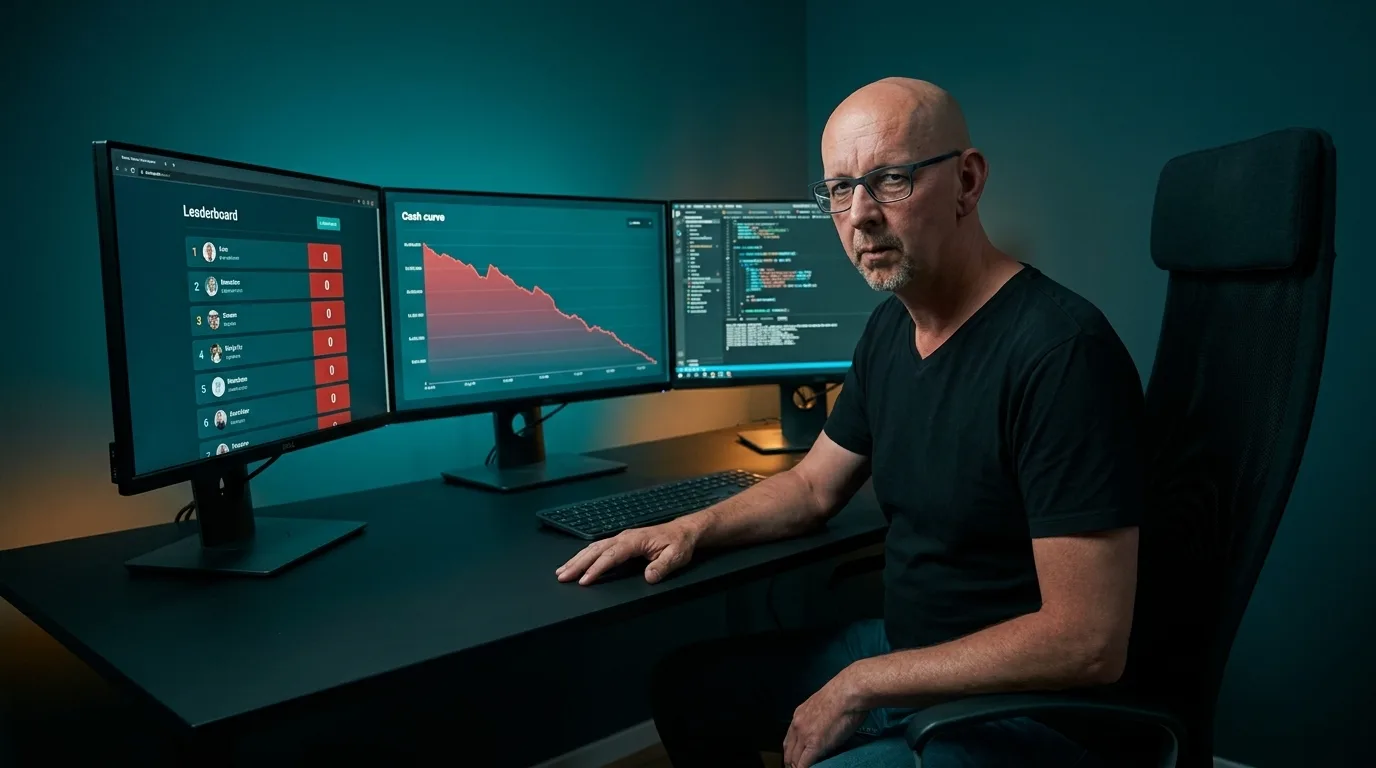
Princeton ran the experiment everyone daydreams about — give an AI control of a company. 13 frontier models, $1M in starting capital, 500 simulated days. Five went bankrupt in every single run. A simple rule-based routine beat 10 of 13. The lesson is not that we need smarter models. The lesson is that we need governance.
Every company runs on a handful of operating beliefs: what "done" means, who decides, whether work gets checked before it ships. Most are written nowhere, which makes them invisible, contradictory, and impossible to enforce.
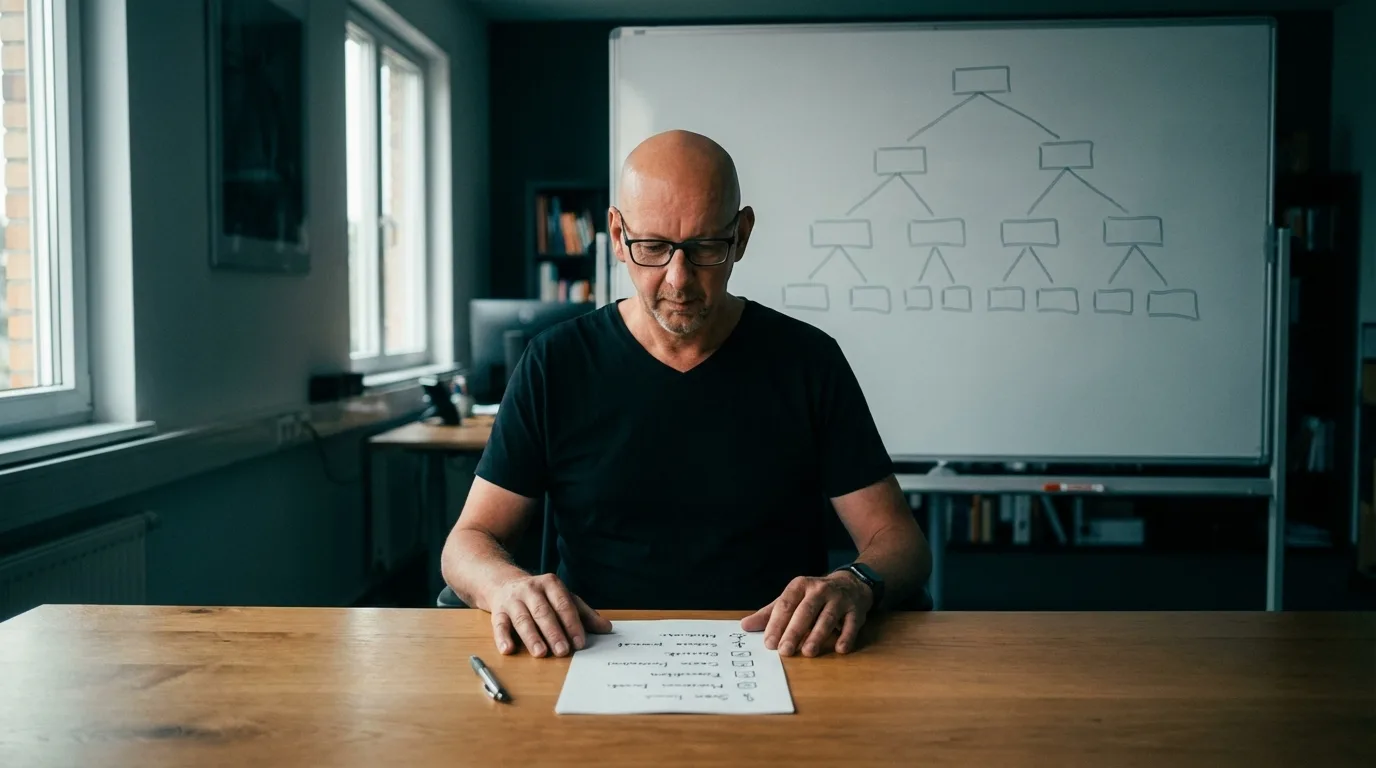
In most founder-led companies, every decision routes through one person: the founder. It feels like control. It's actually the biggest bottleneck. Rocket Routine OS classifies every decision by its impact across four levels, Root, Trunk, Branch, Leaf, and sets who actually decides.
Most rollouts deliver a plan on day one. Rocket Routine OS delivers a working environment: a scorecard, a Control Tower, and a first real result.
Quality is not a judgment call made at the end. Why Rocket Routine OS relies on verification, FTT, and Poka Yoke so nothing ships unchecked.
The Actor Registry separates three actor types: Human Actors, AI Operators, and Knowledge Personas. Accountability becomes traceable in the AI era.
Three stages, one principle. How AI operators take on responsibility through Shadow, Copilot, and Autopilot per role and domain without breaking quality.
Five cadence layers, one loop. Why most strategies fail from missing rhythm, and how Rocket Routine OS enforces cadence structurally.
The four stages of operational maturity: ad hoc, governed, verified, compounding. Why most companies stall below Stage 3, and what it costs.
Companies organize themselves differently, but the underlying functions are identical. Rocket Routine OS defines eleven domains that map every company. Strategy is always active. The other ten are activated when needed.
Lean principles transformed manufacturing. Knowledge work lacks the translation. OMPRIKL is the canonical artifact model that structures Outcomes, Metrics, Principles, Routines, Initiatives, Knowledge, and Learning in every domain.
A prompt is not enough. AI operators need explicit boundaries, decision rights, and quality obligations. The Role Contract is the governance artifact that turns a language model into a reliable operator.
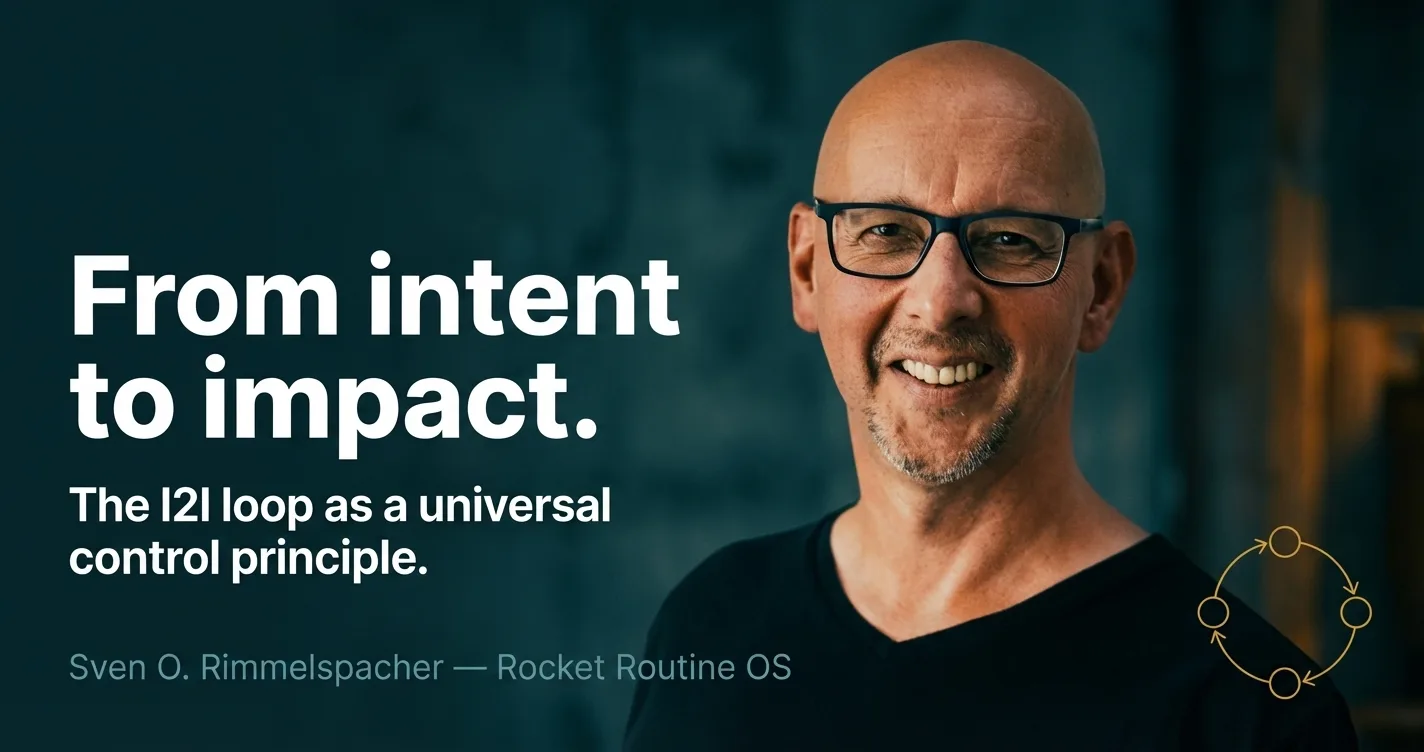
Intent alone does not produce impact. The I2I loop connects Intent, Insight, Implementation, and Impact into a continuous control principle — scalable from individual tasks to quarterly strategy.
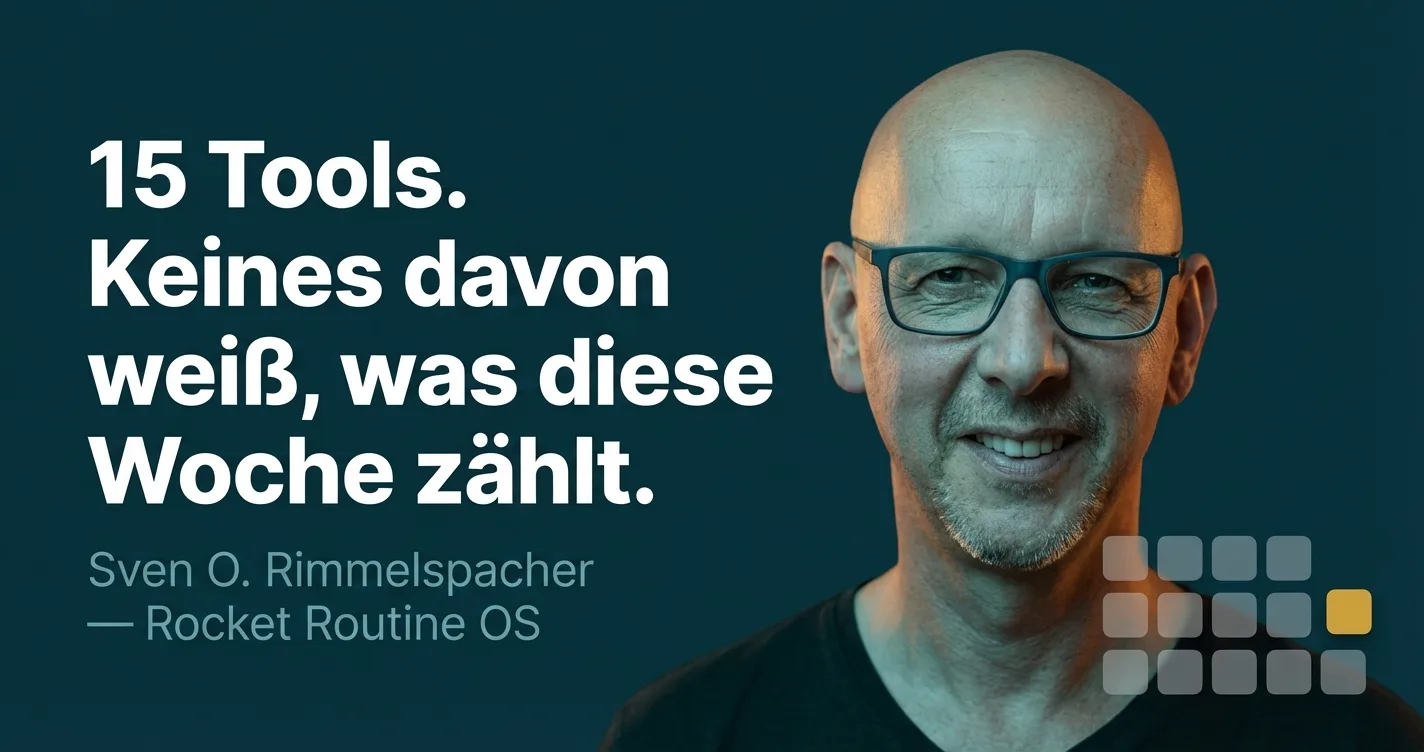
Your company uses 15 tools but none connect strategy to execution. The I2I loop and Control Tower deliver what individual tools cannot: continuous steering from intent to impact.
More than 40 years in software. More than 30 years in quality management. 4 companies at once. Why I'm building Rocket Routine OS: the AI-native operating system for founder-led B2B companies.
A good company vision is more than a poster on the wall. These seven questions test whether your vision really becomes a driving force in daily operations, and how it makes the jump into daily business.
Sustainability isn't a side project — it belongs inside the company strategy itself. Five steps to fold sustainability goals into the same structure as every other strategic goal.
Core values, the tree model, and consent over consensus: how leaders distribute decision authority effectively, and how that tree image echoes in Rocket Routine OS's Decision Impact Classification.
PESTEL, Porter's Five Forces, and analyzing your key competitors: how to systematically assess your market position, and why the analysis only earns its value once it reaches execution.
Team conflict is unavoidable. As a leader, you can use it constructively, strengthen your team, and turn friction into long-term success.
A governed AI operator for company leadership speeds up mission statements, goal planning, and SWOT analyses, but only with clear roles, decision rights, and quality confirmation. What that means in practice, and how it differs from a plain AI assistant.
A mission statement made of purpose, vision, mission, and values only gives orientation when it's more than a poster on the wall. How four building blocks become a constitution companies actually decide by.
Ten retrospective templates and guides for your team, from the Team Clock to the OKR retro, plus a template for summarizing tasks and actions.
Clear accountability, strong communication, and real alignment decide whether a team pulls in the same direction or works past each other. A checklist to test your own alignment.
Four concrete steps to tackle before year's end: a retrospective and strategy review, clear priorities, a meeting cadence, and a real celebration for your team.
AI can significantly speed up the first draft of a company strategy, but only under leadership. How a governed AI operator differs from a loose AI chatbot, and where the limits are.
An effective company strategy comes together in five steps, from environment analysis to goals that reach daily operations. Here's how to develop a strategy that truly moves your organization forward.
Strategic goals describe your company's long-term direction, the where-to over several years. Operational goals are the short-term execution, the measurable steps in day-to-day business that get you there.
Strategy execution comes down to three questions: where do we stand today, where do we want to go, and how do we get there. That turns a strategy into a routine instead of a paper in a drawer.
Guiding framework, strategy patterns, environmental analysis, and goals: the fundamentals of a company strategy that doesn't just look good, but actually holds up in execution.
Most companies have a strategy but no software that keeps it alive. Three criteria for choosing the right tool, and why reporting alone isn't enough.
Successful company strategies balance hard facts like KPIs with the gut feel of experienced leaders. Here's how to find the sweet spot between numbers and intuition.
Douglas McGregor's Theory X and Theory Y explain why expectations of people become self-fulfilling. And why a clear framework like a Role Contract decides whether people take ownership or pull back.
A strategy rarely fails because of the plan. It fails because no one consistently follows through on the action items. Why action items are the decisive factor behind every successful strategy.
Strategy fatigue comes from exhausting meetings, unclear responsibilities, and constant manual chasing. How to spot the causes and build structures that give your team back its energy.
Responsibility without the ability to decide doesn't work. Five developmental stages show how people learn to decide independently, and how Rocket Routine OS applies the same principle to AI operators.
Accountability that hangs on one person is a named dependency risk. Why accountability belongs in the system, not on a person, and what that has to do with Decision Impact Classification and Role Contracts.
Accountable vs. responsible, confidence-level vs. gut feeling: a light-hearted breakdown of the buzzwords from strategy work and goal-setting, and why using them deliberately actually helps.
Crises keep coming, and the VUCA world keeps accelerating. Why that's not a reason to wait on a new strategy, but the best moment to finally carry it through to execution.
An AI chatbot answers on command. A governed AI operator works within clear responsibilities and a quality check. What that means for leadership in practice, and where the limits are.
Rules spell out exactly what to do; principles set the frame and work where no process reaches. Why Rocket Routine OS runs on a handful of enforced principles instead of long rulebooks.
Functional and disciplinary leadership are two different jobs that classic leadership thinking blends together. Why the separation resolves the tension between administration and expertise, and how a Role Contract anchors it for human roles too.
Good decisions rarely fail because of complexity, but because ownership, participation, method, and follow-through were never clarified. Four principles that make this process manageable.
Five elements from a self-developed leadership model that make it possible for several companies to run at once, without anyone needing to personally step in everywhere.
Management systems are more than standards and checklists — they're good management, consistently structured. How a standard-free system like Rocket Routine OS unites strategy and goals in one shared model.
Retrospectives are more than an obligatory sprint-end meeting. Eight reasons why they help every team get systematically better, and the point that's often overlooked: that the learnings actually land.