Microsoft 365 for Rocket Routine OS
Set up in 20 minutes
Your agents reach Outlook mail and calendars, OneDrive and SharePoint files and, read-only, Teams. Everything runs through one app that your IT registers in your own Microsoft tenant; agents never see its secret.
Redirect URL: https://<your-app-address>/api/v1/connections/oauth/callback
In Microsoft Entra (https://entra.microsoft.com), done by your Entra administrator:
- App registrations, New registration. Name "Rocket Routine", account type Accounts in this organizational directory only.
- In the Overview, note the Application (client) ID and the Directory (tenant) ID.
- Certificates & secrets, New client secret. Copy the Value at once (it is shown only once) and note the expiry date.
- Authentication, Add a platform, Web, and enter the redirect URL above.
- API permissions, Microsoft Graph, recommended set:
- Delegated (each person's own connection):
User.Read,offline_access,Mail.ReadWrite,Mail.Send,Calendars.ReadWrite,Files.ReadWrite. - Application (the company-wide connection):
Mail.ReadWriteandSites.Selected. Add more only if agents need it (see Details).
- Delegated (each person's own connection):
- Grant admin consent for your company.
- Limit the company-wide access to the mailboxes and sites agents should use: RBAC for Applications in Exchange Online,
Sites.Selectedin SharePoint.
In Rocket Routine OS, done by an Admin, under Settings, Connections, Microsoft 365:
- Enter the Directory (tenant) ID, the Application (client) ID and the client secret Value.
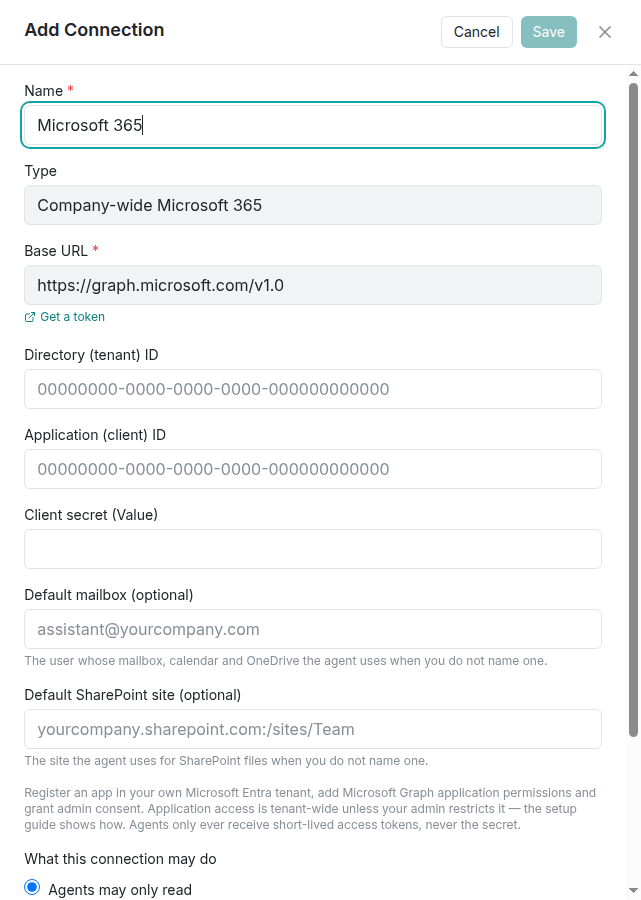
- Choose Agents may only read or Agents may read and change.
- Click Save. Rocket Routine checks the connection right away ("Verifying connection…"). If the check fails, correct the entry and use Retry. Later you can check again from the connection's menu with Test & view tools.
Then each person connects their own account under Microsoft 365 (personal), Connect my account.
The three most common snags
- "An administrator must approve this first": step 6 is missing. Grant admin consent, then connect again.
- "The app does not know this sign-in address yet": the redirect URL from step 4 is missing or differs. Add it exactly as shown.
- "Microsoft refused the app's secret": the secret has expired, or the Secret ID was copied instead of the Value. Create a new secret and save its Value.
Details
Two connections on one app
- Microsoft 365 (company-wide): shared mailboxes and team sites, for example an info@ mailbox or a project site. Set up once by an Admin. Optional: a default mailbox (for example assistant@example.com) and a default SharePoint site (for example yourcompany.sharepoint.com:/sites/Team), used when nobody names one. An agent with this connection can reach every mailbox, calendar and file the company's Microsoft app is allowed to, so give it only to agents that need it.
- Microsoft 365 (personal): each person connects their own mail, calendar and OneDrive. An agent working for that person sees only that person's data. The company-wide connection must exist first, because the personal one uses the same app. For each area (mail, calendar, OneDrive files) the person chooses Do not allow, Read only or Read and change, and whether to allow Send mail as me.
The permissions and why
| Permission | Type | What it allows | Why |
|---|---|---|---|
User.Read |
Delegated | showing whose account is connected | always needed, so the person sees which account is used |
offline_access |
Delegated | staying signed in | always needed, otherwise the personal sign-in ends after about an hour |
Mail.Read / Mail.ReadWrite |
Delegated or Application | reading mail / also drafts, moving and tidying | summaries, finding a mail, preparing replies |
Mail.Send |
Delegated or Application | sending mail | only if mail may be sent |
Calendars.Read / Calendars.ReadWrite |
Delegated or Application | reading / creating events | preparing meetings, finding free time |
Files.Read / Files.ReadWrite (Delegated), Files.Read.All / Files.ReadWrite.All (Application) |
OneDrive and SharePoint files | reading and storing documents | |
Sites.Read.All / Sites.ReadWrite.All / Sites.Selected |
Application | SharePoint sites | team sites; Sites.Selected for chosen sites only |
Team.ReadBasic.All, Channel.ReadBasic.All, TeamMember.Read.All, ChannelMessage.Read.All, Chat.Read.All |
Application | reading teams, channels and messages | reading only; agents cannot post in Teams with this connection |
Add only what your company needs. You can add more later; then grant admin consent again.
Read, or read and change
- Company-wide: set per connection, "Agents may only read" or "Agents may read and change". Searches and other reads always work.
- Personal: each person sets it per area when they connect. Sending, replying, forwarding, sharing a file, deleting and calendar invitations to other people always wait for that person's yes in the Inbox.
- Agents at the Shadow level never change anything in a connected service, whatever the connection allows. They say what they would change, and an Admin can raise their level.
Limiting access
Application permissions reach every mailbox and site in your tenant unless you restrict them. Limit the app to the mailboxes it should use in Exchange Online (RBAC for Applications, or an application access policy). For SharePoint, use Sites.Selected and grant the app only the sites it should use.
What agents can do with it (examples)
- "Summarise the unread mails in our info@ mailbox from today."
- "Find a free hour with me next week and draft the invitation."
- "Put the Q3 budget from SharePoint into the chat as a PDF."
- "Draft a reply to the last mail from the tax adviser." (it stays a draft until the person sends it)
- "What was discussed in the Projects channel this week?"
When it does not work
What Rocket Routine OS shows, and what to do:
- An administrator must approve this first: "Microsoft needs a company administrator to approve this first. Ask your Microsoft 365 administrator to open Microsoft Entra, go to App registrations, open the Rocket Routine app, choose API permissions, make sure the listed permissions are added as Delegated permissions, and click "Grant admin consent". Then connect again."
- The app does not know this sign-in address yet: "The app does not know this sign-in address yet. Ask your Microsoft 365 administrator to add the redirect URL shown here to the app (Authentication, Add a platform, Web). Then connect again."
- Microsoft does not know the app: "Microsoft does not know the app in this company. Check the application ID and directory ID of the Microsoft 365 connection."
- Microsoft refused the app's secret: "Microsoft refused the app's secret. The secret may have expired: ask your Microsoft 365 administrator to create a new one and save it in the company-wide Microsoft 365 connection."
- A permission is missing in the app: "The app has not been given one of the permissions that was asked for. Ask your Microsoft 365 administrator to add it under API permissions as a Delegated permission, or connect again and allow fewer things."
- This account cannot be used: "This Microsoft account is not allowed to use the app. Sign in with your work account, or ask your Microsoft 365 administrator to let you use it."
- The sign-in ends after about an hour: "Microsoft did not allow this sign-in to renew itself, so it will need to be connected again in about an hour. Ask your Microsoft 365 administrator to allow "offline_access", then reconnect."
- The test of the company-wide connection says "Microsoft accepted the credentials, but the app has no application permissions with admin consent yet. In the app registration add Microsoft Graph → Application permissions and click "Grant admin consent"." Do exactly that, then check again (the connection's menu, Test & view tools).
- An agent says it may only read: "Not done: agents may only read through this connection. An Admin can allow changes under Settings, Connections."
Good to know
- The client secret is stored encrypted and is never shown again. Agents never receive it.
- When the secret expires, create a new one in Entra and save it in the company-wide connection. Everyone stays connected.
- Changing the Application ID, or removing the app, means everyone has to connect their personal account again.