
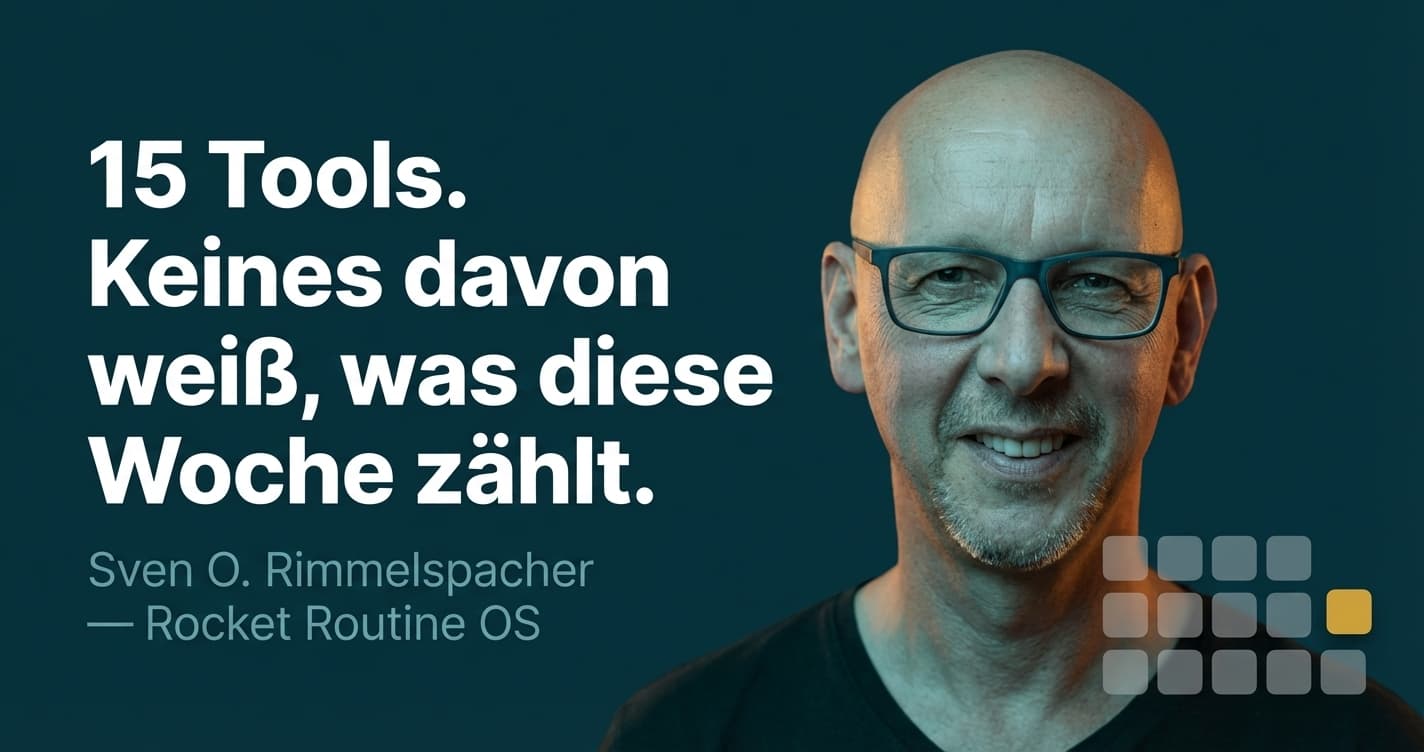
15 Tools, No System: Why Your Company Needs a Control Loop
Your company uses 15 tools but none connect strategy to execution. The I2I loop and Control Tower deliver what individual tools cannot: continuous steering from intent to impact.
In short: Your company may run 15 tools, from CRM to project management to OKR software, and none of them knows what actually matters this week, because no tool sees the context of the others. Rocket Routine OS closes that gap with the I2I loop and the Control Tower.
Count them. CRM, project management, team chat, email, knowledge base, accounting, HR tool, time tracking, OKR software, analytics, file hosting, design tool, support ticketing, calendar, automation platform. Fifteen tools, maybe more. Each one does what it was built to do. None of them knows what your company needs to accomplish this week.
This is not an organizational problem. It is an architecture problem.
Why more tools make it worse
Every tool you adopt solves a local problem. The CRM manages contacts. The project management tool shows tasks. The OKR tool tracks goals. Each one reasonable on its own. Together, they do not form a system.
The reason is structural: no tool understands the context of the others. Your project management tool does not know which strategic goal sits behind a task. Your OKR tool does not know whether the work that is supposed to drive a goal is actually in progress. Your CRM does not know that this week's focus is retention, not acquisition.
What happens: everyone works inside their own tool. Every tool reports progress. But nobody can see whether the sum of that progress actually moves in the right direction.
It is like having 15 instruments in a cockpit, but not a single one shows your altitude.
The real gap
The gap is not between the tools. It is between intent and impact.
You have a strategic intent. Maybe you want to improve customer retention this quarter. Or cut time-to-market for new features in half. Or make the quality of your deliverables measurable.
That intent exists in your head. Maybe in a strategy document. Maybe in a quarterly goal. But the path from that intent to measurable impact is not mapped in any of your 15 tools. There is no continuous thread.
Instead, there are breaks. The strategy is communicated in a meeting. The tasks are captured in a different tool. The results end up in a third. Whether the results match the intent is verified manually at best. At worst, nobody checks.
From intent to impact: The I2I loop
Rocket Routine OS closes this gap with a universal control loop called I2I: Intent to Impact. Everything that moves through the system passes through four phases:
Intent. What needs to be achieved? You define outcomes and constraints. Not as a vague goal, but as a verifiable intent with clear boundaries.
Insight. How will the decision be made? Before work begins, the decision method is chosen explicitly. Not "let's just do it." Instead: what data exists, which decision rule applies, which procedure is used.
Implementation. How is the work executed? Work runs as a routine and is routed through the Control Tower. Not inside an isolated tool, but along a path that is linked to the intent.
Impact. What is the result? Not in the sense of reporting. In the sense of quality confirmation and system change. If the result does not match the intent, the person is not corrected. The process is updated.
This loop is structurally aligned with PDCA (Plan-Do-Check-Act), but it goes further. Impact is not "check" in the sense of "let's take a look." Impact means: when reality diverges from intent, the system changes.
One source of truth: The Control Tower
The I2I loop needs a place where the current state of all work in flight is visible. That is the Control Tower.
The Control Tower is the single source of truth for work in motion. It functions as a Kanban board with state logic: every work item has a defined status. Work does not advance until the next stage has capacity. That is pull logic, straight from the lean toolbox.
What the Control Tower makes visible:
- Status of every work item. Not "in progress" as a catch-all, but the concrete state within the I2I loop.
- Dependencies. Which work blocks other work? Where is something piling up?
- Connection to intent. Every item is linked to the intent that created it.
- Cross-domain coordination. Marketing sees what product is delivering. Sales sees what marketing is preparing.
The Control Tower does not replace your existing tools. It sits on top of them. Your project management tool stays your project management tool. Your CRM stays your CRM. But the Control Tower knows what matters this week, and it knows whether the work inside your 15 tools is actually contributing to it.
Why this is not a dashboard
You might be thinking: this sounds like a master dashboard. Another meta-layer. Another tool that aggregates all the others.
The difference: a dashboard shows you the state. The Control Tower steers the flow.
A dashboard says: "17 tasks are open." The Control Tower says: "These 3 tasks contribute to the quarterly goal, they have capacity in the next phase, they can be pulled now." A dashboard is passive. The Control Tower is an active control element.
And the Control Tower does not stand alone. It is embedded in the I2I loop. Every item that moves through the Control Tower has an intent, a decision basis, an execution path, and quality confirmation. No work item moves through the system without that context.
What this means for your company
Imagine it is Monday morning. You do not open 15 tools. You open the Control Tower. You see: this week, four work packages contribute to the quarterly goal of customer retention. Two are in Implementation status, one is waiting on a decision (Insight), one is complete and awaiting quality confirmation (Impact).
You know immediately: what is moving, what is stuck, what needs to happen next. Not because you checked every tool. Because a system exists that connects intent to work.
This is not a future scenario. It is the architecture we are building in Company 0 right now. Every day, I route my own work through the I2I loop, visualized in the Control Tower. When something breaks down, I do not adjust my work style. I adjust the process. Because processes are the problem, not people.
What comes next
The I2I loop and the Control Tower are the foundation. But a control loop needs actors to execute it. Next week, I will explain how Rocket Routine OS provisions AI operators with explicit responsibilities, decision rights, and quality obligations: Role Contracts.
The complete system design
This article is one piece of the picture. The full architecture of Rocket Routine OS — every concept, every mechanism, the design reasoning behind it — I have written into a single document. 11 pages, free to download, no email required: The Rocket Routine OS System Design Document (PDF)
If you are running a founder-led B2B company with 15 to 50 employees and you want continuous steering from strategy to execution: rocket-routine.com
Frequently Asked Questions
Why isn't having many tools enough to run a company?
Because each tool solves only a local problem and does not understand the context of the others. Your project management tool does not know which strategic goal sits behind a task, and your CRM does not know what matters this week.
What is the I2I loop?
The I2I loop is Rocket Routine OS's universal control loop with four phases: Intent, Insight, Implementation, and Impact. It defines what should be achieved, how the decision gets made, how the work is executed, and whether the result actually matches the intent.
What is the Control Tower?
The Control Tower is the single source of truth for work in motion, built like a Kanban board with state logic and pull-based flow. It does not replace your existing tools, it sits on top of them and shows whether the work is actually contributing to the current intent.
How is the Control Tower different from a dashboard?
A dashboard shows you the state; the Control Tower steers the flow. It does not replace your project management tool or your CRM. It knows what matters this week, and whether the work sitting inside your other tools is actually contributing to it.
Want to build this in your own company?
Rocket Routine OS is the operating system behind these articles, and it is not open yet. Join the waitlist and you hear first, get a fortnightly honest account of what is working and what is not, and move further up the list with every referral.
Join the waitlistWant to understand the whole system?
The entire architecture of Rocket Routine OS as a PDF — 20 pages, freely available, no form required.
Download whitepaper (PDF)