
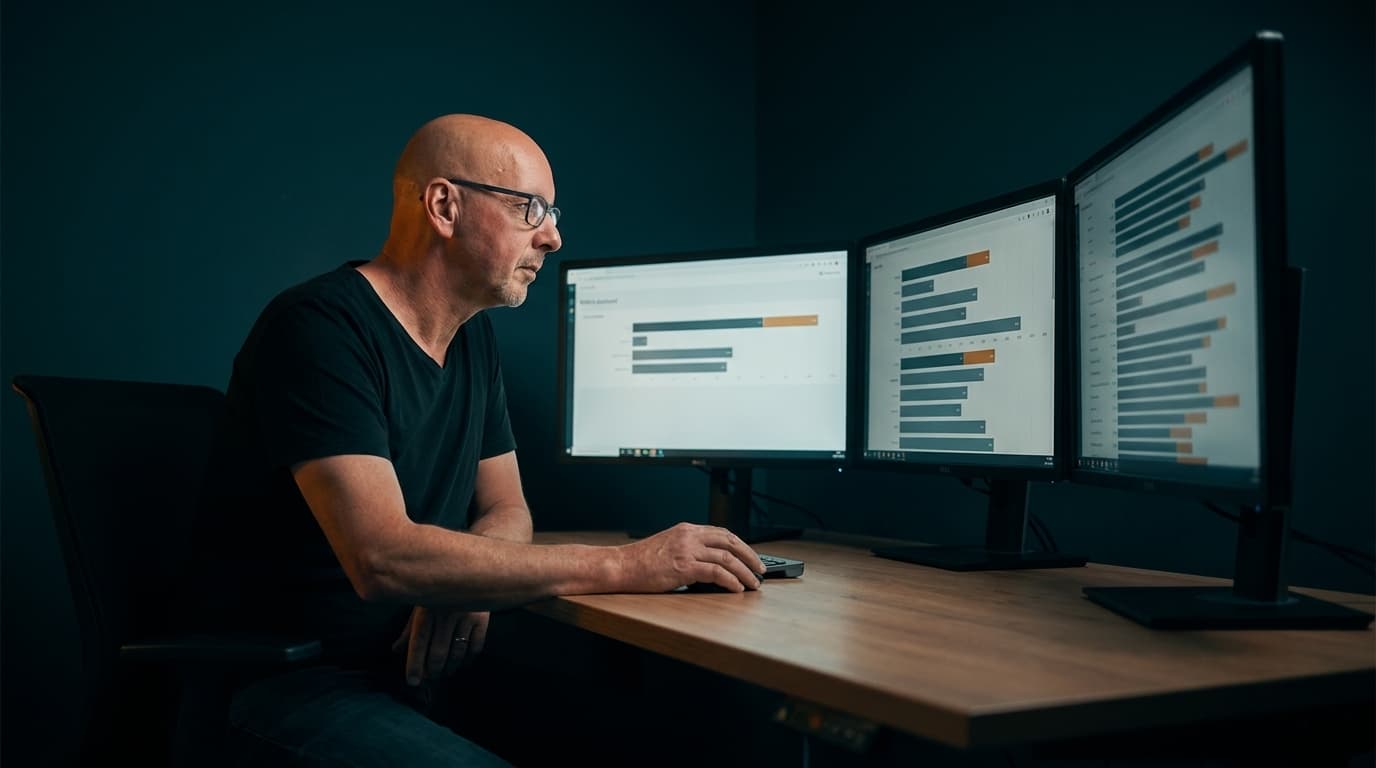
Founder, Growth, Scaling: Three operating modes
Letting go isn't a character trait. It's a property of the system behind you. The three operating modes of Rocket Routine OS, explained.
Every CEO eventually gets the same advice: learn to let go. Delegate more. Build trust. The advice sounds reasonable. It's still useless.
Letting go isn't a character trait. It isn't a question of maturity, courage, or self-confidence either. It's a property of the system standing behind you. When the system can't carry the weight, letting go isn't a strength. It's a diffusion of responsibility.
Letting go isn't a character trait. It's a property of the system standing behind you.
What the three modes are
Rocket Routine OS distinguishes three operating modes. A company can run in one of them, or in different ones simultaneously across different parts of the business.
Founder Mode. The CEO does everything. Decides, executes, reviews, corrects. AI operators assist, but every decision passes through one person. That isn't inefficient. It's the correct configuration for a particular phase.
Growth Mode. Routines are executed by AI operators. The CEO leads by exception: stepping in only when the system raises an escalation. Decision rights are explicitly distributed. Outputs are verified, not supervised.
Scaling Mode. The system runs autonomously inside explicit governance. The CEO works at the strategic layer. The job is no longer steering what happens. It is configuring how the system itself is set up. Operational decisions are made and verified by the system.
These three modes aren't career stages. They're system states.
Why most CEOs get stuck
The standard diagnosis: the CEO can't let go. Control freak. Micromanager. Bottleneck.
The standard diagnosis is wrong.
Look at any company stuck in Founder Mode when it should be running in Growth Mode, and you'll almost always find the same picture:
- Routines aren't standardized. There's no single answer to the question of how a task should be done correctly.
- Decision rights aren't explicit. Nobody knows exactly what they're allowed to decide and what they have to escalate.
- Quality isn't verified. Outputs get shipped because someone says they're done, not because they were checked.
Under those conditions, holding on isn't irrational. It's the only way to keep the company together. Telling a CEO in that situation to let go is asking them to remove the safety net before they know whether there's a floor underneath.
What makes the shift possible
The transition from Founder Mode to Growth Mode is not an act of personal development. It's the moment three structural conditions are met at the same time:
- Routines are defined as executable artifacts, not handbooks.
- Role Contracts make decision rights, tool access, and escalation triggers explicit.
- Quality is confirmed through verification, not by the CEO being in the room.
Only when those three conditions are in place does delegation stop being a hope. It becomes a verifiable operation.
Once the system handles verification, delegation stops being a hope. It becomes a verifiable operation.
The shift to Scaling Mode follows the same logic. The CEO doesn't step back because of personal growth. The CEO can step back because the system now structurally carries decisions that used to require their attention.
What doesn't happen
Three things that don't happen in any of these modes:
The CEO doesn't lose sovereignty. Even in Scaling Mode, the CEO remains the final authority. They keep deciding at the root and trunk levels. They aren't handing over the company. They're handing over the routines.
The system doesn't make strategic decisions. Existential questions stay with the CEO or the owners. Operational decisions migrate into the system because rules, verification, and escalation make them carriable there.
The modes aren't a one-way street. A company can move from Growth Mode back into Founder Mode if a market shift demands it. The mode follows reality, not a roadmap.
What I see in Company 0
Rocket Routine GmbH currently runs in a mix of Founder Mode and Growth Mode. Some routines, like the weekly content production, run in Growth Mode: AI operators produce, I review by exception. Others, like the strategic decisions about the platform itself, run in Founder Mode.
What I observe: the shift doesn't happen through a decision. It happens at the moment when, for a specific routine, I have enough verification data to say the system does this more reliably than I do, with less effort, at higher quality.
The transition isn't emotional. It's data-driven.
What this means for you
If you feel like you can't let go, the problem probably isn't inside you. The problem is that your company hasn't yet met the structural conditions for Growth Mode.
The question isn't how to become the CEO who can let go. The question is which structural gaps are keeping your company in Founder Mode.
The question isn't how to learn to let go. The question is which structural gaps are keeping your company in Founder Mode.
Next week I'll look at the Maturity Ladder: the four stages a company moves through, from ad hoc to compounding. It's the answer to the question of how to build those structural conditions, step by step.